
This guide grew from months of observing and listening at Beree-Badalla Boardwalk on Currumbin Creek.
It’s what I wish I had when I first started getting to know this place.
Choose a little doorway below and get to know the neighbours you meet along the way.
Birds are remarkably good at announcing themselves without showing their faces.
Try the free Merlin Bird ID app to help identify who’s singing.
Its Sound ID feature listens for bird calls and suggests possible matches.
It’s not always right, so use it as a clue, then see if you can spot the singer for yourself.
What’s That Bird?20 feathered neighbours
What’s That Bird?
Try Merlin Bird ID for birdsong clues. Check its suggestions against what you see and hear.
Pied Currawong
Strepera graculina
Jalwang / Jarwang -Pied Currawong / Currawong (Yugambeh Name)
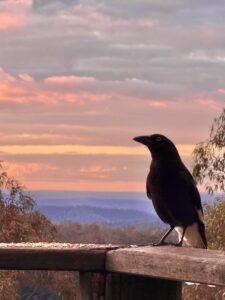
ID clue: Bright yellow eyes, white tail tips and small white wing patches distinguish this mostly black bird from a crow.
Wait, what?! It stores prey in tree forks and crevices as a food larder. A meal for later, tucked away above the path.
Sources / review
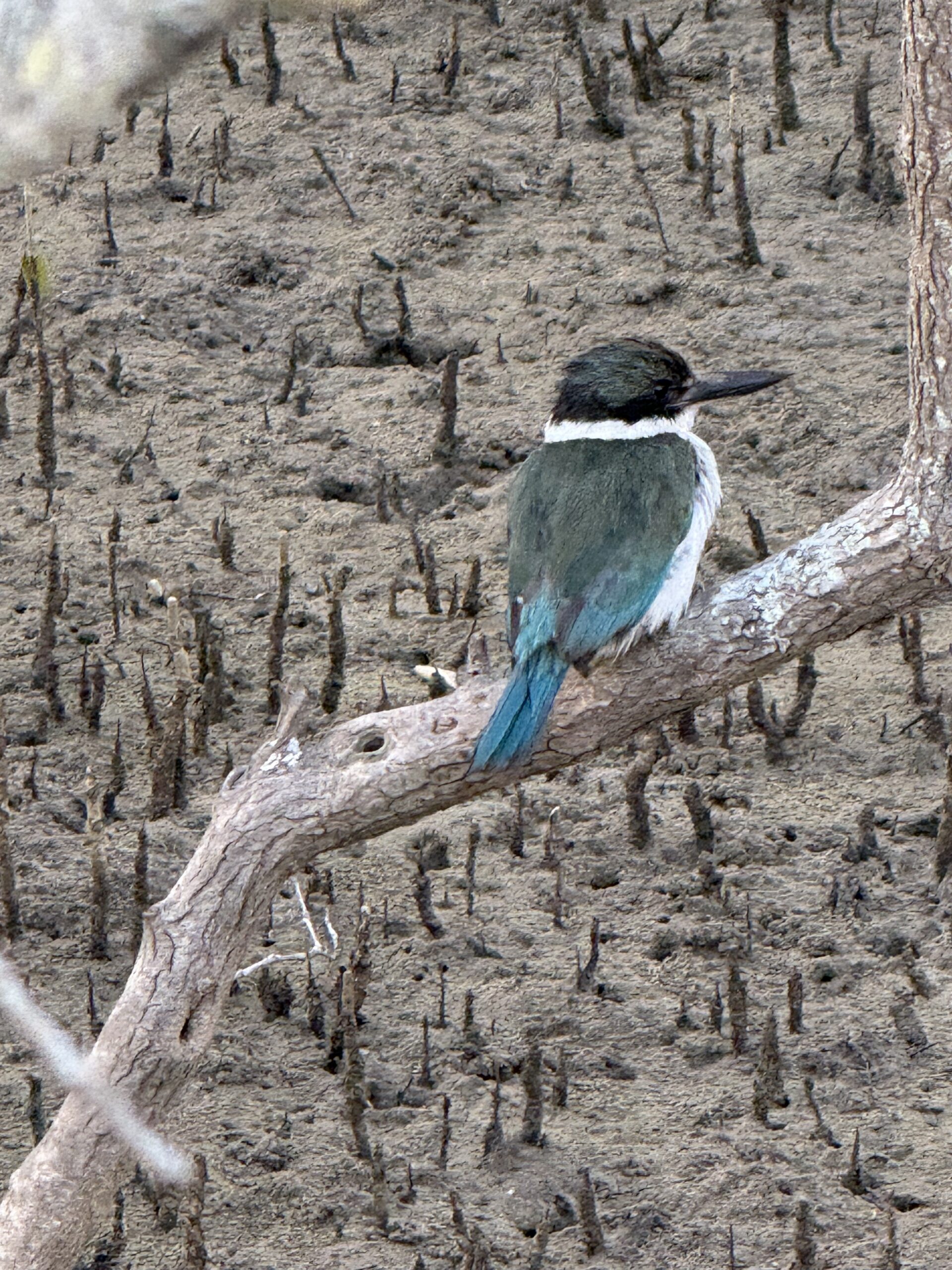
Torresian Kingfisher
Todiramphus sordidus
dih-dih (deedee) in Yugambeh
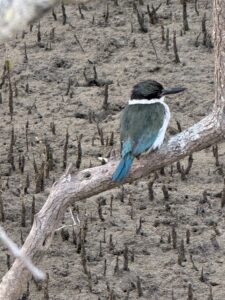
ID clue: Look for clean white underparts, a broad white collar and a substantial bill; Sacred Kingfishers usually look smaller and buffier below.
Wait, what?! Its catch can be a mud crab. This kingfisher has a documented taste for the mudflat’s clawed neighbours.
Olive-backed Oriole
Oriolus sagittatus
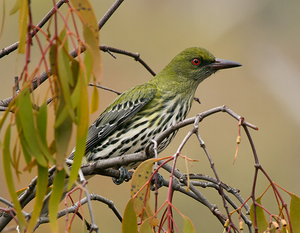
ID clue: A reddish adult bill helps separate this streaky, olive-backed bird from the similarly coloured Figbird, which has a dark bill.
Wait, what?! It can imitate other birds’ calls. That apparently mixed chorus may include just one very accomplished mimic.
Sources / review
Mangrove Gerygone
Gerygone levigaster
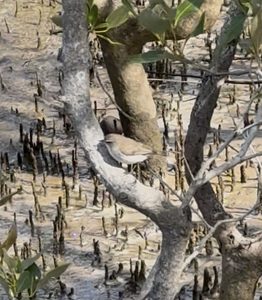
ID clue: A broad, pale eyebrow above a dark reddish eye is more useful than simply looking for a tiny brown bird.
Wait, what?! Some adults weigh only five grams: a whole living bird, with its feathers, bill and feet included.
Sources / review
Australasian Figbird
Sphecotheres vieilloti
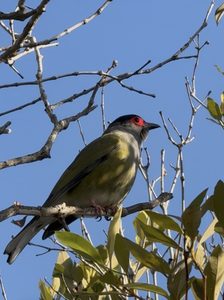
ID clue: Adult males have bare red skin around a dark eye; females have grey eye skin and streaked underparts. Both have dark bills.
Wait, what?! Its nest can hang by its rim from an outer branch fork: a suspended canopy nursery.
Sources / review
Yellow-tailed Black Cockatoo
Zanda funerea
Wayilahr – Yellow Tailed Black Cockatoo (Yugambeh Name)
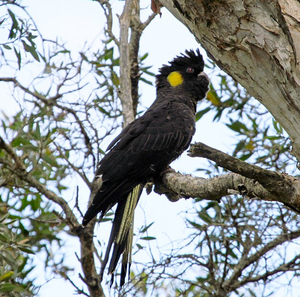
ID clue: Yellow tail panels and a yellow cheek patch identify this large black cockatoo; red-tailed and glossy black cockatoos lack this combination.
Wait, what?! A youngster can remain dependent on parental care for about six months. Quite a lengthy apprenticeship.
Sources / review
Torresian Crow
Corvus orru
Wagahn – Torresian crow (Yugambeh Name)
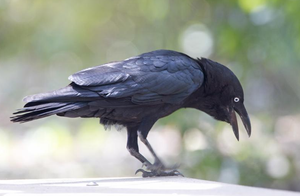
Identification clue: Glossy black, with short throat feathers, white adult eyes and a nasal “uk-uk-uk”. Watch for a wing-shuffle on landing.
One extraordinary thing: Some Torresian Crows flip cane toads over to eat them while avoiding their poisonous glands. A rather clever way around a dangerous dinner.
Sources / verification
Australian Museum · identification
Queensland Government · cane-toad feeding
Little Egret
Egretta garzetta
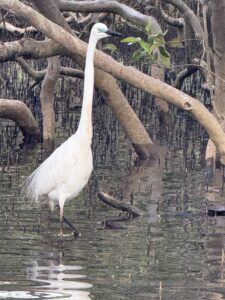
ID clue: Look for a small white egret with a slender black bill and dark legs; size and bill colour matter together.
Wait, what?! It can spread a wing to shade the water while stalking prey, carrying its own portable sunshade.
Sources / review
Pacific Koel
Eudynamys orientalis
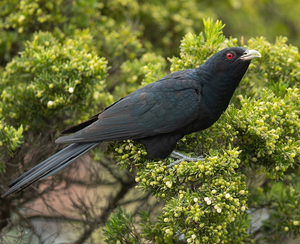
ID clue: Adult males are glossy black with red eyes; females are brown, white-spotted above and finely barred below. They look strikingly different.
Wait, what?! It lays eggs in other species’ nests, leaving those birds to raise its young.
Sources / review
Rainbow Lorikeet
Trichoglossus moluccanus
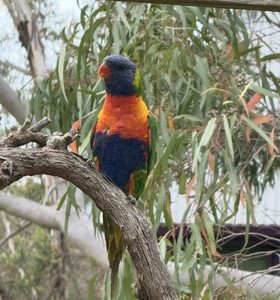
ID clue: A blue head above an orange-and-yellow breast separates it from the green-headed Scaly-breasted Lorikeet. Check the chest as well as the wings.
Wait, what?! Its brush-tipped tongue gathers nectar and pollen: flower-feeding equipment hidden inside that bright beak.
Sources / review
Sulphur-crested Cockatoo
Cacatua galerita
Girayir / Gireh -is Sulphur Crested Cockatoo , also which also translates to Kirra , the suburb of the same name and meaning! (Yugambeh Name)
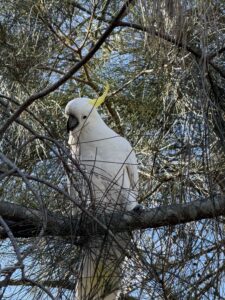
Identification clue: A large white parrot with a sulphur-yellow crest and dark grey-black bill; yellow flashes beneath the wings in flight.
One extraordinary thing: In Sydney, cockatoos learn to flip wheelie-bin lids by watching one another. The trick spreads through neighbourhoods: a little cockatoo culture.
Sources / verification
Australian Museum · identification
Australian Museum · social learning research
Welcome Swallow
Hirundo neoxena
bujay-bujay, bujabuyay in Yugambeh
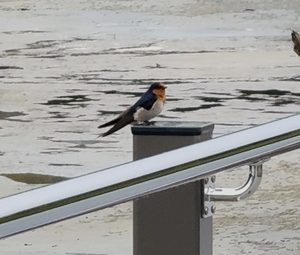
ID clue: The rusty throat and long forked tail distinguish this swallow from white-rumped, squarer-tailed martins; young swallows have shorter tail streamers.
Wait, what?! Tiny bristles beside its bill help guide flying insects into its mouth. An aerial meal with built-in guidance.
Sources / review
Pied Butcherbird
Cracticus nigrogularis
gol’goru’n Butcher bird in Yugambeh
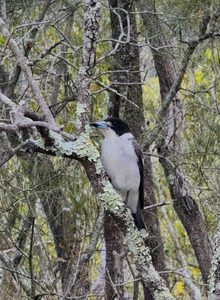
ID clue: A black throat and broad white collar distinguish an adult from a Grey Butcherbird, which has a pale throat.
Wait, what?! More than one female may lay eggs in the same nest. The family arrangements behind that fluting voice can be unexpectedly communal.
Noisy Miner
Manorina melanocephala
Bim-bim in Yugambeh
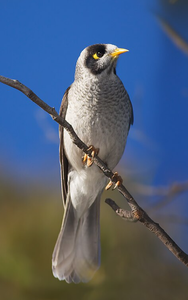
ID clue: A mostly grey body, yellow bill and bare yellow eye patch distinguish it from the brown-bodied Common Myna.
Wait, what?! Chicks can receive meals from helpers as well as parents. Those extra feeders are almost always male: a shared neighbourhood nursery.
Sources / review
Silver Gull
Chroicocephalus novaehollandiae
Gawgahri (Kowgahrie) name in Yugambeh
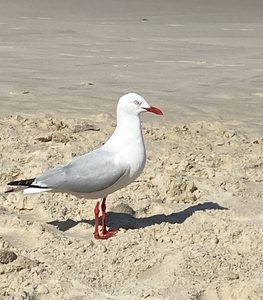
Identification clue: Adults have a white head, pale grey back, black-tipped wings and bright orange-red bill and legs; youngsters have darker bills.
One extraordinary thing: Silver Gulls can tremble their feet in soft ground to bring food to the surface. That little dance has a purpose beyond looking fabulous.
Spotted Dove
Spilopelia chinensis
possibly mumbiri-mumbiri for small dove in Yugambeh
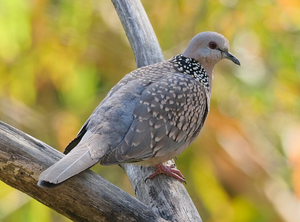
ID clue: Look for the black neck patch dotted with white; young birds lack the adult’s strongly spotted collar, so check age before deciding.
Wait, what?! Its nest may be so sparse that the eggs are visible through the twigs from below.
Sources / review
Australian White Ibis
Identification to confirm
Muru, murah (moro, murroo) nose in Yugambeh
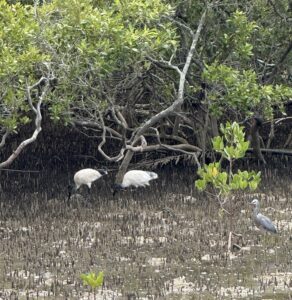
Clue / review: White body, bare black head and neck, long curved black beak. Yes, it’s the famous bin chicken!
One extraordinary thing: Before it became a professional bin raider, the ibis was a wetland wanderer. Its beak has sensitive nerve endings that help it find hidden creatures in the mud without even seeing them. A built-in treasure detector!
Masked Lapwing (Plover)
Vanellus miles
Deber, Debira-dilbehra, Debra-debra in Yugambeh
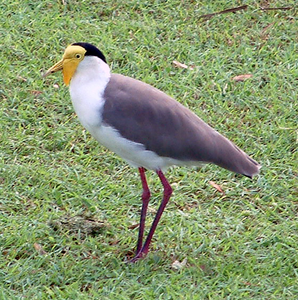
ID clue: Large yellow facial wattles, a black cap and long legs identify this familiar plover; the yellow facial mask is especially conspicuous.
Wait, what?! Each wing has a sharp spur at the wrist. Ordinary-looking wings conceal an extra defensive tool.
Sources / review
Magpie-lark (Mickey Bird)
Grallina cyanoleuca
Birlbirin (peewee) in Yugambeh

ID clue: This small black-and-white bird has a pale eye; adult males have a black eye stripe, while females have a white brow and throat.
Wait, what?! Pairs synchronise alternating calls and wing movements into a coordinated song-and-dance duet.
Dusky Moorhen
Gallinula tenebrosa
Mubay-mubay in Yugambeh
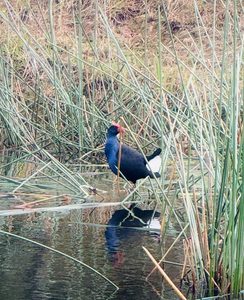
ID clue: A red bill with a yellow tip separates adults from purple swamphens with all-red bills and coots with white bills.
Wait, what?! Breeding territories can be shared by groups of two to seven adults. A waterside family need not be just a pair.
Sources / review
Meet the Mangroves5 remarkable survivors
Meet the Mangroves
The Snorkeller
Grey mangrove
Avicennia marina
Mangrove is Jangigir (jungeegerie) in Yugambeh language
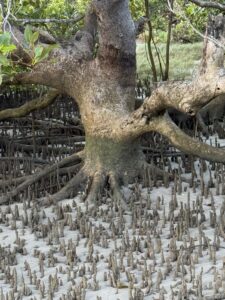
ID clue: Pencil-like breathing roots and a pale, slightly hairy grey leaf underside distinguish it from the other featured mangroves.
Wait, what?! It tackles salt twice: limiting entry at the roots, then excreting some through leaf glands. A tree with its own salt-management system.
Sources / review
The Milkshake Queen
River mangrove
Aegiceras corniculatum
Mangrove is Jangigir (jungeegerie) in Yugambeh language
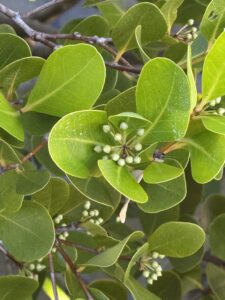
ID clue: Spoon-shaped leaves with rounded tips and curved, horn-like fruit distinguish this shrub from the larger-leaved mangroves.
Wait, what?! Its clusters of white flowers can have a banana-like smell. An unexpectedly fruity scent from a tree growing beside salty water.
Sources / review
The Magic Mangrove
Red / spotted mangrove
Rhizophora stylosa
Mangrove is Jangigir (jungeegerie) in Yugambeh language
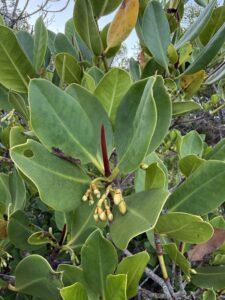
ID clue: Arching prop roots and reddish-brown dots beneath leathery leaves distinguish this mangrove; the roots form stilts around the trunk. FIND THE FRECKLES!!
Wait, what?! Seeds germinate while attached to the parent, growing into long propagules before dropping. A seedling starts life before leaving home.
Sources / review
The Rogue Goddess
Orange mangrove
Bruguiera gymnorhiza
Mangrove is Jangigir (jungeegerie) in Yugambeh language
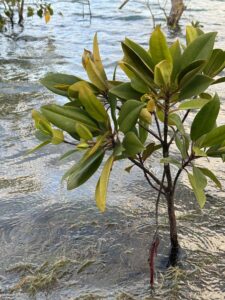
ID clue: Look for bent knee roots rather than grey mangrove’s pencils or red mangrove’s stilts; large opposite leaves provide another clue. MUCH bigger longer, leaves too.
Wait, what?! Its flowers release pollen explosively when a visitor trips the mechanism. A tiny botanical catapult hidden inside a mangrove bloom.
The Mystery Guest
Yellow mangrove — locally reported
Ceriops sp. — species to confirm
Mangrove is Jangigir (jungeegerie) in Yugambeh language
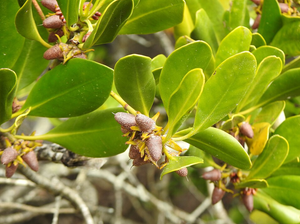
Clue / review: Look for small, glossy, oval leaves and slender, pencil-like propagules hanging from the branches. Yellow mangroves can also have distinctive buttressed roots.
One extraordinary thing: Yellow mangroves have a rather clever sun-avoidance trick: their leaves often point upwards to reduce exposure to the fierce midday sun. Even trees know when it’s time to dodge the Queensland heat!
Crabs with Character5 mudflat encounters
Crabs with Character
Who will you be waving at today?
Juvenile semaphore crab
Species to confirm
jabi-jabi is crab in Yugambeh language
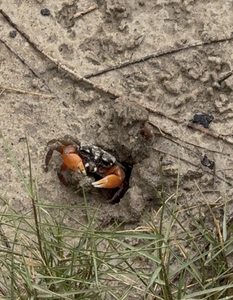
Clue / review: Look for a tiny, dark-bodied crab with bright orange claws, long eyes on stalks and two similarly sized pincers.
One extraordinary thing: These little crabs change their claw colours as they grow! Their claws can progress from greenish to orange, pink and eventually purple in mature males. It’s a rather fabulous coming-of-age wardrobe change.
Purple dancing / ADULT semaphore crab
Identification to confirm
jabi-jabi is crab in Yugambeh language
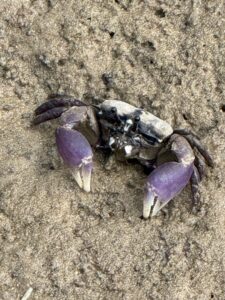
Clue / review: Look for a tiny, purple-bodied crab with long eyes on stalks and two similarly sized pincers.
One extraordinary thing: males wave their claws like tiny signal flags, communicating with other crabs. Researchers think these displays are involved in courtship and territorial disputes.
Fiddler crab
Species to confirm
jabi-jabi is crab in Yugambeh language
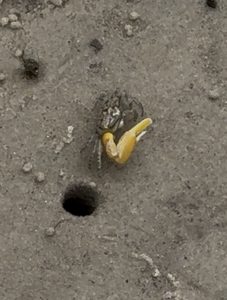
Clue / review: the crab with one conspicuously oversized yellow claw.
One extraordinary thing: That giant claw can weigh up to half the crab’s total body weight. Imagine dragging around one arm that weighs as much as the rest of you!
Female fiddler crabs often fancy a fellow with a bigger claw! Males wave their oversized pincers to attract a mate, and that ridiculous appendage can double as a cooling system. Romance meets air conditioning
Mystery Black-and-blue crab
Identification pending
jabi-jabi is crab in Yugambeh language
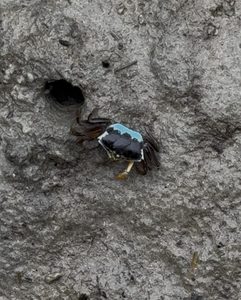
Clue / review: striking electric blue and black shell with yellow claws and dark legs
One extraordinary thing: the extraordinary thing is I can’t seem to figure this one out! Help me identify it if you can.
Swimming crab
Identification pending
jabi-jabi is crab in Yugambeh language
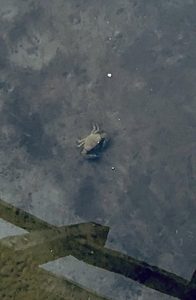
Clue / review: Portunid crabs are characterised by the flattening of the fifth pair of legs into broad paddles, which are used for swimming.[1]
One extraordinary thing: I saw this one at sunrise, but another mystery to solve as it’s pretty far away to figure out just what kind it is!
The Unexpected Encounters5 little surprises
The Unexpected Encounters
For plant clues, try Seek by iNaturalist.
Estuary Stingray
Hemitrygon fluviorum
Wayan, Wehn is stingray in Yugambeh language
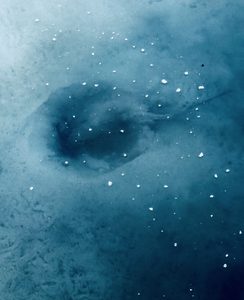
Identification clue: Look for a yellow-brown, diamond-shaped disc, a long tail and a row of thorns along the back towards the tail base.
One extraordinary thing: In Moreton Bay, these rays have been found eating numerous soldier crabs. The mudflat’s tiny marching neighbours have some large dinner guests.
Sources / verification
Common Toadfish
Tetractenos hamiltoni
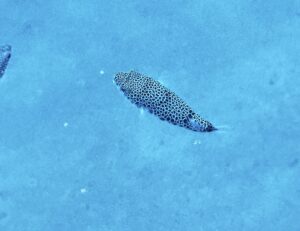
Identification clue: Sandy-white with small brown spots across the back and upper sides; brown bars or blotches often mark the lower sides.
One extraordinary thing: Its corneas can turn yellow in bright light by adjusting pigment cells. Built-in sun filters for those watchful little eyes.
Sources / verification
Australian Museum · identification
Fishes of Australia · yellow corneas
Observe without handling. Common Toadfish are highly toxic and must not be eaten.
Shrimp
Species to confirm
Mulayim in Yugambeh language
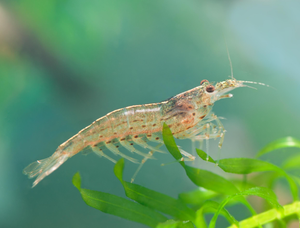
Clue / review: You’ll have to sit long enough starting at the roots to notice these tiny almost transparent critters, they often hang out with the little schools of tiny fish.
One extraordinary thing: Shrimps grow by shedding their outer covering through moulting. This is a general crustacean fact; the photographed shrimp still needs its own identity.
Sources / review
Reference 1 · Identity still to review.
Dolphin
Species to confirm
Gawandeh / Gawandah, Gawanday in Yugambeh Language
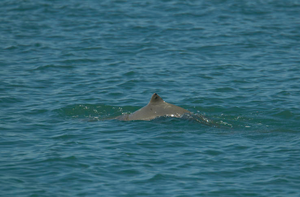
Clue / review: Listen for the splashes and breathing above water.
One extraordinary thing: Dolphins use echoes from their own sounds to navigate and find prey. This is a dolphin-group fact, rather than a claim about an unconfirmed species.
Sources / review
Reference 1 · Identity still to review.
Ruby Saltbush
Enchylaena tomentosa
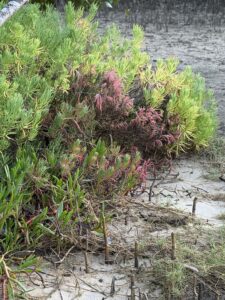
Identification clue: Fleshy, cylindrical, water-storing leaves; little red or orange fruits. The mangroves aren’t the only ones dealing with all this salt.
One extraordinary thing: Birds carry its seeds away. I wonder if the bird has any idea it’s been recruited as a gardener?
Photograph Credits
The following bird photographs are reproduced under Creative Commons licences. Thank you to the photographers who have generously made their work available.
• Olive-backed Oriole — Photograph by Patrick_K59. View original photograph, via Wikimedia Commons. Licensed under CC BY 2.0.
• Yellow-tailed Black Cockatoo — Photograph by Greg Schechter. View photograph, via Wikimedia Commons. CC BY 2.0.
• Torresian Crow — Photograph by Lip Kee Yap. View photograph, via Wikimedia Commons. CC BY-SA 2.0.
• Pacific Koel — Photograph by JJ Harrison. View photograph, via Wikimedia Commons. CC BY-SA 4.0.
• Noisy Miner — Photograph by JJ Harrison. View photograph, via Wikimedia Commons. CC BY-SA 3.0.
• Masked Lapwing — Photograph by Guillaume Blanchard. View photograph, via Wikimedia Commons. CC BY-SA 1.0.
• Magpie-lark — Photograph by Wayne Butterworth. View photograph, via Wikimedia Commons. CC BY 3.0.
• Spotted Dove — Photograph by Satdeep Gill. View original photograph, via Wikimedia Commons. Licensed under CC BY-SA 4.0.
• Yellow Mangrove (Ceriops australis) — Photograph by Greg Tasney. View original photograph, via Wikimedia Commons. Licensed under CC BY-SA 4.0.
• Australian Snubfin Dolphin (Orcaella heinsohni) — Photograph by Mononykus. View original photograph, via Wikimedia Commons. Released under CC0 1.0 (Public Domain Dedication).
• Shrimp: “In Between”, photograph by Victor Kong. View original photograph, via Wikimedia Commons. Licensed under CC BY 3.0. •

Photographs may be resized or cropped for display. Where photographs have been adapted, the resulting image adaptations are subject to the applicable Creative Commons licence conditions. All other original artwork and photography remain the property of their respective creators.
A Little Project Story (and a Lot of Thank You’s)
A year ago, this was a dream.
A rather ambitious, slightly ridiculous dream that somehow grew legs, wings, pincers and eventually made its way onto a boardwalk.
First, thank you to my incredible friends and family who knew this was a dream long before it became a reality. Thank you to the people who wrote letters of support. Without your faith in me, this project wouldn’t have got off the ground, let alone above a boardwalk.
Thanks to Lisa for letting me use her unlimited internet until late in the evening, and Mowgli, Bella and Quill for animal hugs when I was crying over technological fails.
Thank you to the people who, when I asked how much their services would cost for a much smaller grant application, actually budgeted their time properly. You made me realise just how desperately I’d underestimated the work involved. You helped me reach higher, ask for more and be a little more realistic about what it would actually take to bring this thing to life.
Thanks especially to Gina for her invaluable boardwalk knowledge and amazing life chats.
Thanks Clint for the many laughs and giggles and being understanding when I had the occasional moment of tearing up over how much this place touched me.
Thanks to Mike and Liv for helping me edit the scripts! Without you, I would have made it taste funny.
Thank you to the person who gave me some truly horrible, generic, heart-and-gut-punching feedback about my script four days before recording. It hurt. A lot. It also pushed me to rewrite almost the entire thing in five rather frantic hours before heading off to record.
It’s all the better for it. Sometimes the gifts don’t arrive wrapped particularly nicely.
Thank you to the friends who’ve willingly let me talk their ears off, point ridiculously excitedly at birds and exclaim, “WHAT IS THAT?!” for approximately the hundredth time. Then, rather than rolling their eyes and walking away, helped me find out. I love you for that.
Special thanks to Arthur who hung off the boardwalk for me to see if we could get better underwater photos because I wanted to detour our breakfast while in our ‘going out’ clothes because I REALLY needed to get that underwater shot I was craving.
I know I have more drive than patience, thank you for supporting me.
Mostly, thank you to the birds.
To the curious little faces who’ve greeted me on my walks, the songs I’ve slowly learnt to recognise and the kingfisher with whom I’ve developed what I consider to be a rather special friendship.
I’m completely enchanted.
Thank you to the surprise dolphins, the HUGE stingray who blessed me with their presence and the crabs who occasionally waved back.
Thank you to the lady who stopped to ask if I was okay while I was recording at 5 am, sitting perfectly still and covered from head to toe because the midges were absolutely destroying me. I wasn’t homeless. I just looked it. Haha.
This project has been so much more than making an audio trail. It’s been an exercise in asking for help, accepting it, listening more carefully, being willing to get things wrong and discovering just how much wonder is waiting in places we think we already know.
I’ve felt blessed, humbled, wildly excited and, more than once, genuinely worried that I wouldn’t do this place or this project justice.
If you ever have the chance to explore a dream, I highly recommend it.
Go big, go outside.
The universe met me halfway.
I’m so glad I reached out.
I really hope that this listening trail has brought this place alive with fresh eyes
and a thirst for slowing down and looking again, with your elbow this time 😉
Thank you for reading all the way to the end you curious little soul….
Amanda x